


A Variety of Audiences
Our project has been exploring bears across the country, as well as in Bankside’s arenas. But we also know they were royal favourites, and the Master of the Bulls, Bears, and Mastiff Dogs answered to the King or Queen and served their interests. After all, in 1600, an exasperated John Dorrington wrote to Philip Henslowe about the short notice demanded by Elizabeth I for bears and dogs: “I have Received a letter to have her Majesty’s games to be at the court of Monday next; so short a warning as I never knew the like” (Dulwich College Archives, MSS002, 003). Accordingly, we are interested in the locations where bears, dogs, and other animals appeared before the crown and their guests.
How do we know where they appeared?
The National Archives hold the records of the Pipe Office, which contain the Exchequer accounts kept each year by the royal treasurer. These accounts offer useful insight into early modern play and game culture, because they document various crown expenses on everything from football to dramatic performance, typically with details (from vague to specific) on dates and places.
Payments in these records reference bears and dogs baiting at all points in the year. They fall broadly into two categories: 1) fees paid to the Master of the Game at the time for bringing/presenting/showing/etc the game, 2) fees paid to gentleman ushers for “making ready” a venue for play. Gentleman ushers, prominent servants in the royal household, testify to a wider business and activity surrounding recreation at court that encourages us to look beyond named Masters of the Game to understand bearbaiting’s social and cultural presence there.
These lists also track all the official holders of the title “Master of the Bears, Bulls, and Mastiff Dogs” since 1572: Richard Darrington, Ralph Bowes; Henslowe and Alleyn; Gabriel Marsh, Thomas Caldwall, Michael Fitch, Thomas Manley and Thomas Davis.
How do they describe the presence of bears?
The vocabulary in these accounts varies between “showed,” “brought,” “gave attendance,” and “presented”: i.e. “Henslowe paid for presentinge before King and Prince Palatine barebaytinge on the seaventh of Aprill” (TNA E351/544, 14b, 7 April 1613); “Edward Bowes for bringing the said game to the Queen on St John’s day, 100s” (E351/542, 79a, 27 Dec. 1585); Thomas Bowes for bringing “game of Parrisgarden before her Ma{ies}ti{e}” (E351/451, 197a, 1575).
These words perhaps tell us something about the reception of bearbaiting, at least at elite levels, where the terminology offers close parallels with other forms of spectacle. Terms like “presented,” in particular, suggest a double sense that covers the office of the Master of the Game (who is “presenting” his game) and the nature of the game itself (a formal display for viewing and consumption). This “showing” language can help us contextualise animal blood sports not only in scholarly terms but in comparison to the likes of Shakespearean performance. After all, they occupied the same playing spaces.
Where exactly did they appear and what else was going on?
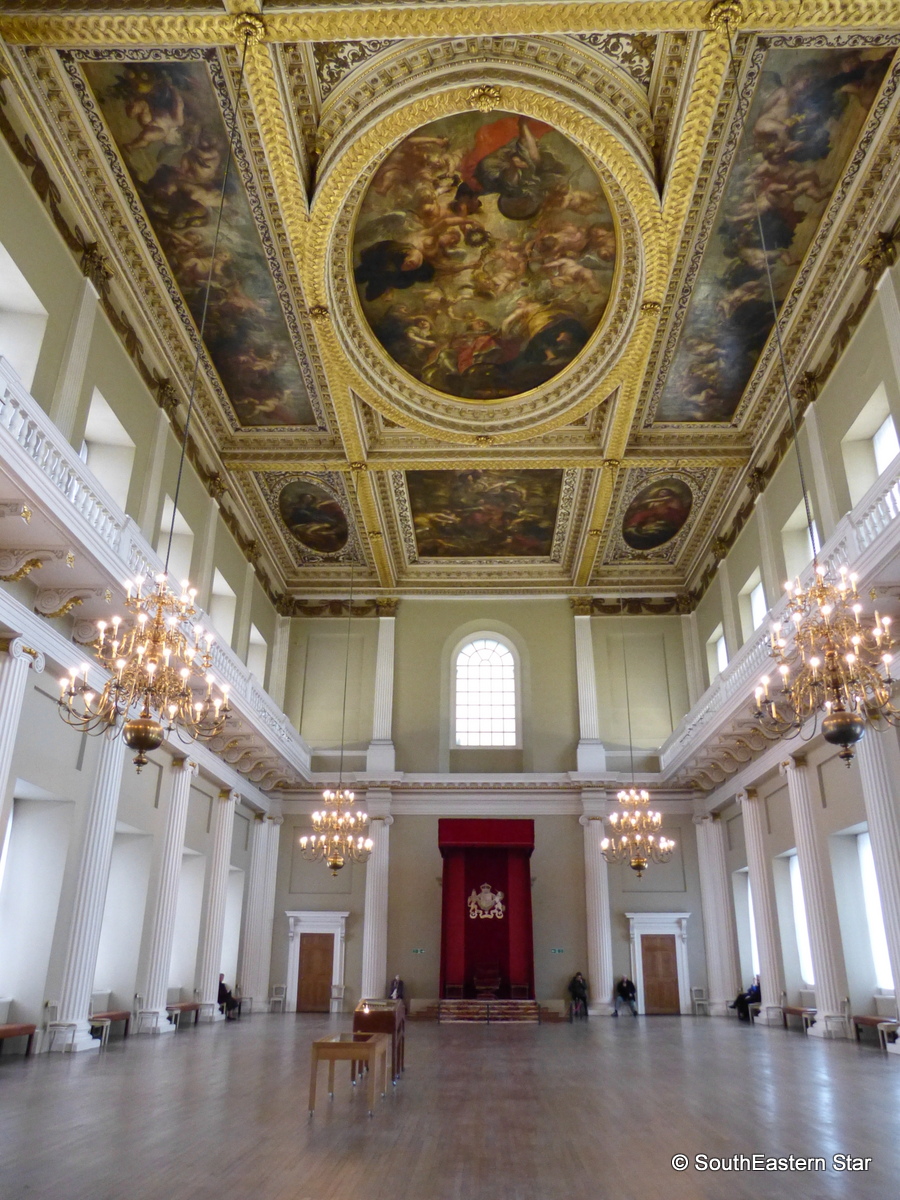
The locations bears were “presented” are sometimes surprising. Whitehall’s Banqueting House was in one week prepared “twyce for playes and once for Bearebaytinge” (TNA E351/544, 10b; April 1613).
Other entries in the Treasury records show bearbaiting taking place alongside football, cockfighting, fencing, and sermons: in August 1613, Coningbsby made “ready a standing” at the royal residence of Beaulieu “to see the play at footeball […] and a standinge to see the Bullbaytinge” (10a)—an early modern football terrace!; in early summer of 1620, Thomas Footes was paid “for making ready the houses of Bromham and Beaulieu “for five sermons and for Bullbayting” (TNA E351/544, 115b) and Richard Coningsby altered and made ready the Council Chamber at Whitehall “to see the sporrtes in the preachinge place” in May 1607 (TNA E351/543, 173b).
The Banqueting House by the date of the bearbaiting entry cited above in 1613 was part of a long tradition of entertainment spaces in “houses” separate from the palace itself. Inigo Jones’s famed iteration of the Whitehall Banqueting House, the one still standing today, was not completed until 1622, but baiting took place in the venue through to at least the late 1630s.
This space is today typically framed in terms of the high Renaissance; the Historic Royal Palace’s entry on the Banqueting House deems it a “masterpiece of classical architecture” and emphasises both its structural form and “beautifully carved” decorative details, which apparently point to its “original purpose […] as a venue for masque performances.”
The idea of large animals like bears inhabiting and sharing this space, with dogs competitively set upon them, sits quite at odds with this genteel vision of the ornamental Renaissance. It asks us to ponder the exact spatial possibilities of having bulls, bears, and dogs in the Banqueting House during the same week it hosted a series of plays (or did the sport in fact take place nearby, with the phrase standing in as representative of a broader location?).
Other intriguing locations include “the prince’s lodgings” at Greenwich, frequent appearances at the tiltyard and surrounding “standings,” and the “gallery” at Whitehall. These elite spaces framed and housed noble pursuits and pastimes. They provide a fascinating contrast to alehouse yard baitings common across the country, but they also speak to similarities in adapting leisure spaces to suit the “show” at hand.
In this sense, royal spaces of play mirror closely popular venues in the multiplicity of their uses. Each accommodated a whole range of leisure and entertainment within a short time span, reminding us that early modern recreation was a broad category whose genres or types often shifted and blurred as they sat within the same architectural compass.
What did such spaces look like?
We can recover something of the aesthetics of court performance (in comparison to regional popular performance) by noting some of the other visual details listed in these accounts: in 1621 (the same year Alleyn presented his game before the King), Richard Calverley was paid for “taking down riche hangings at whitehall after Easter and apparrelling it with ordinary stuffes” (145a). In fact, similar furnishings characterised Canterbury’s public bullstake, which included hanging escutcheons that were variously taken down or put up. In both royal and popular spaces, rarefied aesthetics sat happily alongside animal activity, the decoratively beautiful alongside the ostensibly beastly.

Comments