



Figs 1-6. Click each image for the full caption.
Seeing Bears in Europe
Bear baiting proliferated in England during the medieval and early modern periods, with bear pits in large cities and small towns, and touring bear wards who would show off their animals in fights stages all around the country. Across the Channel in mainland Europe, however, it is much more difficult to know if bears were baited. A conspicuous lack of French, German, Italian, or other European documents concerning the treatment of bears and other animals in bloodsports leads us to consider different kinds of evidence to understand this phenomenon.
This post aims to examine ideas of public and private spaces and popular and elite culture, asking for whom depictions of bears were made, who viewed them, and the purposes they may have served. It follows Liam’s post on seeing bears in medieval Europe.
Glimpsing Bears in Parisian Street Life
While finding archival evidence of bear baiting in eighteenth century France can be difficult, we know that bears were made to dance in the streets of Paris. Scenes of Parisian street life can offer a glimpse into the presence of these animals in the life of the city.
A 1775 etching by the printmaker Simon-Charles Miger [1736-1828] shows a small brown bear, possibly a juvenile, being led along the cobblestones by its handler (Figure 1 in gallery). Miger’s print workshop was located on Paris’ Rue St Jacques: a street lined with printing presses producing huge numbers of engravings and etching to be sold to a wide audience.
Muzzled, leashed on a chain, and accompanied by two monkeys dressed in overcoats and tricorn hats, Miger’s diminutive bear cub causes a scene of excitement as it is paraded. People lean out of their windows to better see the animal, while a cacophony of noise accompanies the proceedings: from the cry of the children’s rabble and the seller of chestnuts walking behind the bear, to the blowing of flutes and a bagpipe called a musette, and the barking of dogs. A crouching woman in the foreground to the left of the scene does her best to restrain a snarling dog. Others, perhaps strays, run in the direction of the bear cub.
The presence of these dogs in Miger’s scene must not be read outright as evidence of baiting having been practised. An accompanying poem explains that the cub is a dancing bear that performs tricks for public amusement. While the cub’s owner may have wished to prevent any harm coming to the young bear, parading it at street level exposed the animal to the potential dangers of the city that Miger represents.
Where might we find baiting in eighteenth-century Paris?
Alongside the print trade of the rue St Jacques, the Salon was another artistic sphere in which bears and violence might be encountered, this time in painted form, by eighteenth-century Parisians.
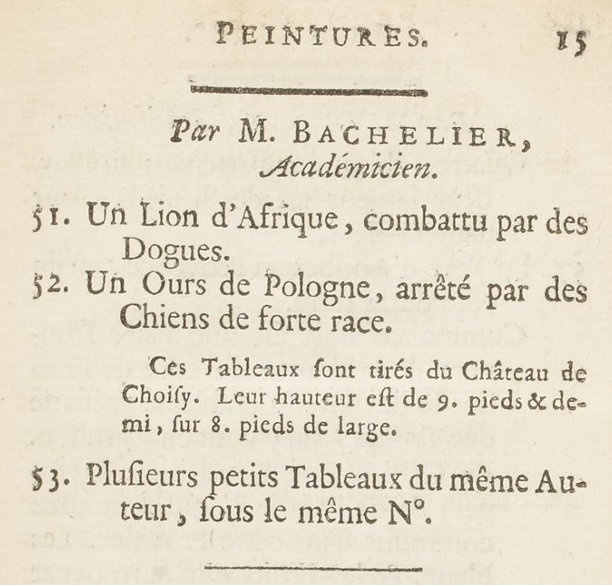
The Salon was an exhibition of paintings, sculptures, drawings and prints, held in the Louvre, which first began in 1699 and occurred more or less annually from 1737, lasting into the early twentieth century. (See Figure 2 in the gallery for an image of the catalogue.)
The purpose of the show was to publicly display works by members of the Académie: the official body of painters based in Paris whose elected officials’ work was supposed to represent the pinnacle of French art and culture. The Salon cost nothing to enter, so that the Parisian public could see the crowning achievements of the royally-founded Académie.
Free entry made the Salon an unprecedented space for social mixing, and it provided a space outside of the extremely hierarchical society of eighteenth-century France, divided in all areas by titles and status. In 1777 the critic Mathieu-François Pidansat de Mairobert [1727-1779] wrote of the Salon that
the…odd-job man rubs shoulders with the great noble…the fishwife trades her perfumes with those of a lady of quality, making the latter resort to holding her nose to combat the strong odour of cheap brandy drifting her way.
While bear baiting may be hard to find in archival sources and popular printed imagery, the Salon offered a space where such practices could be represented.
The official catalogue – called the livret – for the 1757 Salon exhibition records the painter Jean-Jacques Bachelier [1724-1806] exhibiting a number of works, including a 9×8 feet canvas titled A Polish Bear Assailed by Well-Bred Dogs (Un ours de Pologne, arrêté par des chiens de forte race) (see Figure 3 in gallery). The work, now in the collection of the Musée de Picardie in Amiens, shows a startled-looking bear standing on its hind legs with its arms outstretched as it fights off eight muscular mastiffs. Two of the dogs appear to have been tossed, while a further two more hang onto the bear by their jaws.
How allusive are these scenes?
Scenes of animal violence, even featuring bears, were not exclusive to the eighteenth century and instead formed an artistic convention which Bachelier’s painting draws on, referencing the work of seventeenth century artists such as Frans Snyders [1579-1657] and Peter-Paul Rubens [1577-1640] who similarly painted bears and other large animals under attack from dogs and huntsmen.
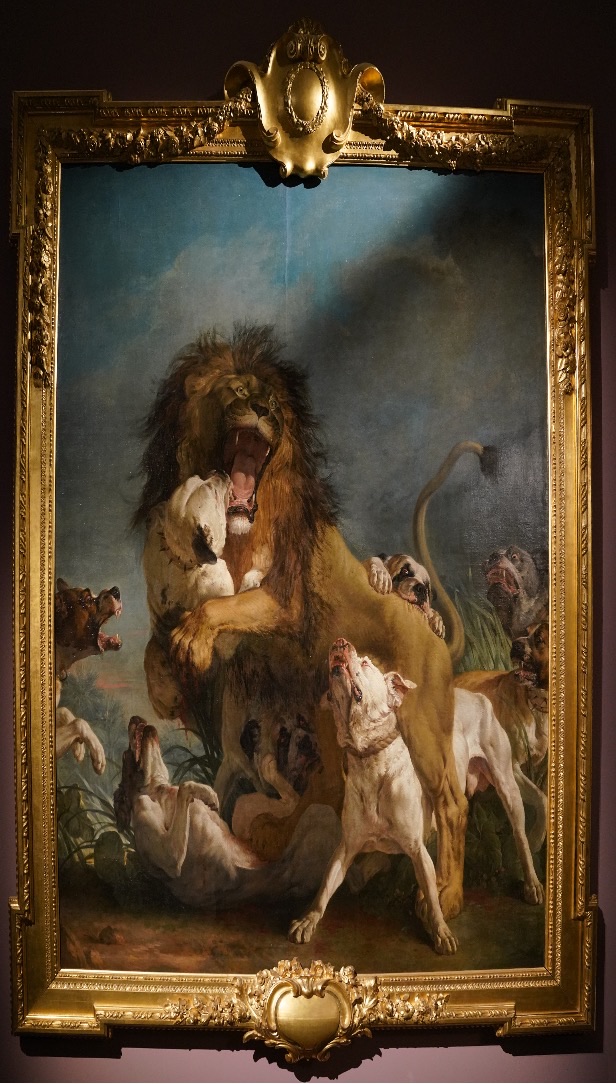
Bachelier’s 1757 painting was accompanied by a second work Un lion d’Afrique, combattu par des dogues (An African Lion Fought by Dogs), similarly exhibited in the 1757 Salon, and now also held in the collection of the Musée de Picardie in Amiens (Figure 4 in this blog’s gallery). The exotic nature of the African lion adds an element of fancy which complicates seeing the Polish bear painting as a document of baiting practices.
Does the scene of the bear and the mastiffs draw on a culture of bear baiting in eighteenth-century France, or does it instead refer more to the art historical tradition of painting large exotic mammals assailed by dogs?
Can paintings provide evidence of an elite culture of bear baiting?
If Bachelier’s bear painting does reference baiting, then it is not a scene from the street like Miger’s etching of the bear cub. The fight between the bear and the dogs takes place in an outdoor setting, with a rocky outcrop forming a kind of natural arena, and there is no visual reference to the urban environment. The painting was shown publicly at the Paris Salon, but its history points away from the culture of the capital towards the private elite society of eighteenth-century France. The work was commissioned for King Louis XV’s hunting palace at Choisy, a building richly decorated with depictions of hunting, dead animals, and animal violence.
Louis XV [1710-1774] was an avid hunter whose regimen of stag hunting occupied much of his time. Contemporaries commented that is was such an all-consuming passion that it left little time for his other kingly duties. While hunting was an almost daily mainstay of life at Choisy, we do not know if bear baiting was also part of the courtly entertainments featuring animal violence.
The life-size scale of the animals in Bachelier’s painting seems to approximate the experience of standing in front of a bear baiting scene. Salon exhibitions were often hung with smaller works nearer to the bottom of the room, gradually increasing in size, to allow for better visibility of all the exhibited works. This method of hanging would have lessened the effect of standing next to a painted baiting scene, but it is unsure where in Choisy the work was hung, and what relationship to the elite viewers this may have evoked.
Bachelier’s bear and lion pictures paired together reference an art historical tradition of animal painting at the French court where exotic creatures were depicted being assailed by dogs, however the works cannot be relied on as documentary scenes of real-life practices of animal cruelty for the purposes of entertainment.
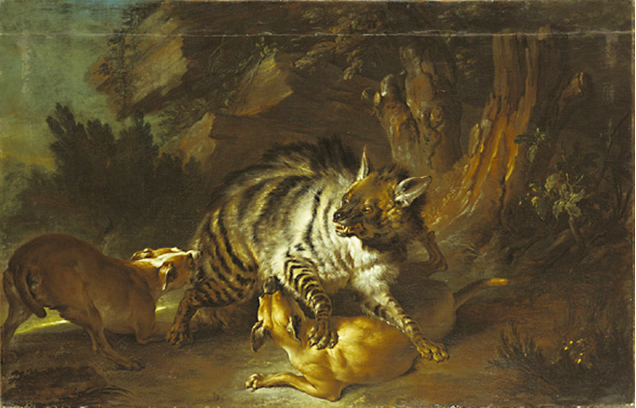
A 1739 painting by the celebrated court animal painter Jean-Baptiste Oudry [1686-1755], originally painted for Louis XV but now in the collection of Ludwigslust Palace, shows a striped hyena being attacked by mastiffs (Figure 5 in this blog’s gallery). No account of Louis XV’s menagerie at Versailles mentions such an animal, and it is uncertain if this work is a stylised picture in the manner of earlier painters such as Snyders, or if it records a real-life practice of baiting rare and exotic creatures at the French court.
Did animal cruelty occur in other European courts of the eighteenth century?
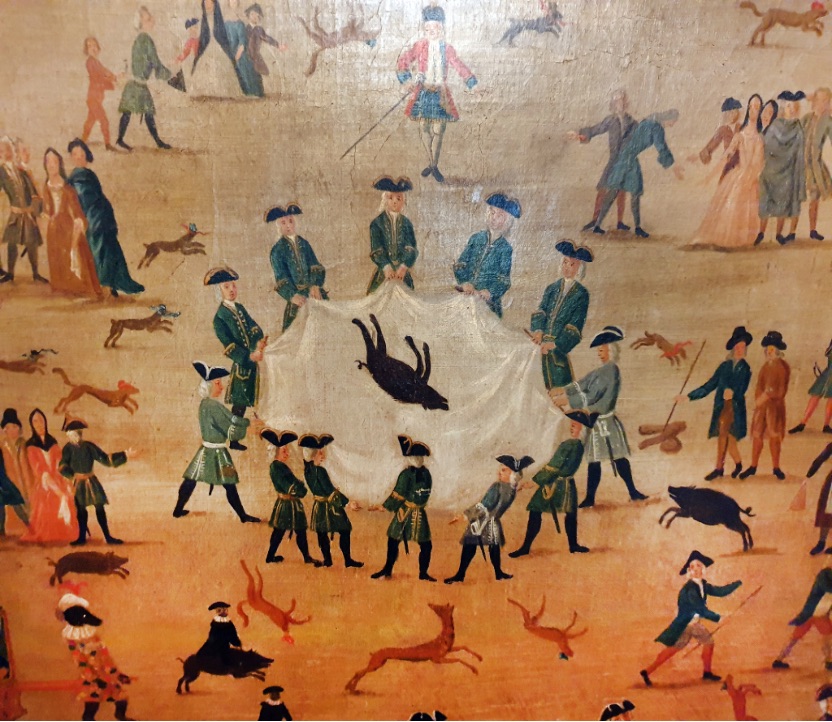
Elsewhere in Europe, away from France, animal cruelty as a form of courtly entertainment took many documented forms. In the Holy Roman Empire (modern-day Germany) rulers such as Augustus the Strong of Saxony [1670-1733] were famous for their love of ‘tossing’ foxes and boars: a practice where animals would be flung higher and higher on sheets until the pain from broken bones and repeated trauma would eventually lead to death.
A 1720 painting (figure 6 in this blog’s gallery) now in the collection of Jagdschloss Grunewald illustrates a circle of Prussian courtiers tossing a boar on a sheet, standing amidst a flurry of running foxes and boars, and watched on by members of the court.
Aside from hunting, it is not documented whether the French court ever engaged in pre-arranged spectacles of animal violence such as the scene of multiple German courtiers hurling animals in the air.
Conclusion
Miger and Bachelier’s works help us consider bears in eighteenth-century Paris where archival and textual sources are lacking.
From dancing to fighting mastiffs, it seems that the place these animals held in their culture was no less violent than across the Channel in England. However, depictions of any kind are not documentary sources, and are informed by art historical conventions, and symbolic conceptions such as the human/animal divide, as well as the expectations and beliefs of their audiences.
By examining the print culture of the rue St Jacques, the Paris Salon, and the Château de Choisy, this blog has introduced a number of contexts in which humans may have viewed bears in eighteenth-century France.
Paintings, etchings and other kinds of visual sources can help us to begin to think further about who saw and interacted with bears, and for what purposes, and the ways that bears and other animals formed part of the cultural life of eighteenth-century France.

Comments